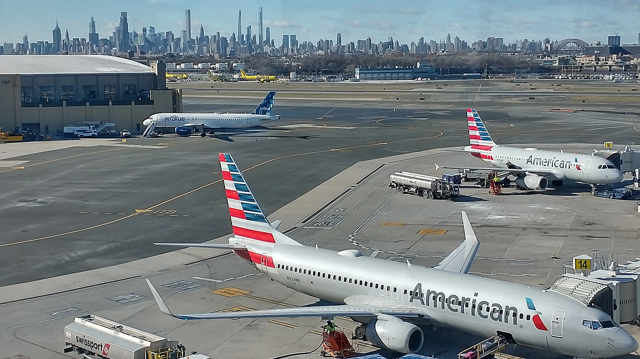
25 years after 9/11: Air travel safer, but 'we'll never reach 100% security'
National News

Audio By Carbonatix
9:34 AM on Wednesday, September 9
Morgan Sweeney
(The Center Square) – Some Americans only know what it’s like to travel in airports with post-9/11 security, but there are many who still remember what it was like to fly 25 years ago.
Air travel remains much changed since the terror attacks of Sept. 11, 2001, and most of the lasting changes have made flying safer for Americans, according to aviation security specialist Jeff Price.
9/11 findings
After 19 men hijacked four planes 25 years ago Friday, the nation's aviation security system needed to respond. The 9/11 Commission concluded that multiple “layers” of security failed leading up to the attack.
“The FAA set and enforced aviation security rules, which airlines and airports were required to implement. The rules were supposed to produce a ‘layered’ system of defense,” the report reads. “But each layer relevant to the hijackings — intelligence, passenger prescreening, checkpoint screening, and onboard security — was seriously flawed prior to 9/11.”
The report included evidence that the hijackers likely used knives to gain control of passengers and crew, and federal policy at the time permitted knives with blades shorter than four inches on flights. Box cutters, which were also believed to have been carried aboard, were prohibited under an FAA-approved checkpoint operations guide. The commission found, however, that the guide provided no further guidance to screeners on how to distinguish between prohibited box cutters and permitted pocket utility knives.
“Pre-9-11, airline contractors or airline personnel themselves were doing the screening to the level the government required,” Price said. “The airlines were meeting the standards, by and large, but the standards were very, very low.”
Though the report concluded that airport screening was weak, Price, a metropolitan airport manager on 9/11 and former assistant security director at Denver International Airport, said its findings showed that the greater failure was in the policies governing screening rather than their implementation. Price is now a professor and has also authored Practical Aviation Security: Predicting and Preventing Future Threats, among other books critical to his field.
"To say that screening was a joke prior to 9/11 would be giving credit to a joke. It was virtually non-existent,” Price told The Center Square.
The advent of TSA
In November 2001, Congress passed the Aviation and Transportation Security Act, which created the Transportation Security Administration and ultimately transferred airport screening from airlines to the agency. Prior to 9/11, airlines typically contracted with private security companies to meet basic passenger and carry-on baggage screening requirements set by the Federal Aviation Administration. Occasionally, screeners were employees of the airlines themselves. Screeners were typically paid at or near minimum wage.
Screeners at almost all U.S. commercial airports today are employed directly by TSA. A small group of airports still contracts with private companies for screening but under the authority and oversight of TSA.
Today, TSA employs about 60,000 people and screeners’ starting pay is generally around $20 an hour or more, depending on location, along with federal benefits and scheduled opportunities for pay increases.
A new security landscape
In addition to the TSA, many other things changed about flying.
Before 9/11, passengers faced far fewer restrictions on access to the cockpit, and pilots sometimes welcomed children and other passengers inside before takeoff.
“Pretty much anybody could [say], ‘Hey, can I meet the captain’ or something like that before you took off. Sure, no big deal,” Price said. “‘Can my kid come up there and sit for a few minutes?’ That kind of stuff happened. Not anymore. That all goes out the window.”
Over time, cockpit doors were reinforced and fitted with stronger locks.
No-fly lists existed before 9/11, but they were greatly expanded afterward, leading to today’s watch-listing and passenger-vetting system.
Prior to 9/11, airports were much more accessible to the general public. Friends and family could greet loved ones or see them off at their gate.
“You just walked through the checkpoint. They didn’t care if you were a passenger, a meeter, a greeter, dropping people off, or just going to the airport to have dinner at a restaurant out there by the gate,” Price said. “Anybody could go through a checkpoint.”
But that all stopped after Sept. 11. Identification and travel documents also became part of the screening process, so that only passengers and authorized personnel could access the airport beyond the security checkpoint.
Post-9/11 incidents like what happened with the “shoe bomber” in December 2001 led to shoe removal often being incorporated into the screening process, and a plot deterred by British authorities in 2006 to blow up multiple transatlantic planes using liquid explosives led to TSA banning liquids from carry-ons. The agency later relaxed that rule to liquids not exceeding 3.4 oz fitting in a quart-sized bag.
Airport technology also got a huge upgrade.
“The technology in use at the time… it was basically 1970s technology that really had not advanced that far over the course of time. Not what you see today, with these multi-view X-ray machines and computer tomography, imaging devices, and body imagers,” Price said. “We didn’t have any of that.”
TSA also coordinates with airports today on the size of the law enforcement presence at each facility.
"If you want 100% security in flying, quit flying"
The threats to commercial aviation continue to evolve, according to Price, who expressed concern over drone technology.
As relatively inexpensive attack drones have become an integral part of the Russia-Ukraine war and more recently, in the conflict involving Iran and the U.S. in the Middle East, they’ve also become a concern for aviation security. On Aug. 4, a drone carrying explosives was discovered at a German airport, reportedly near Ukrainian cargo aircraft.
“Drones worry me,” Price told The Center Square. “We need drone detection systems deployed to airports, and some have them. I think that needs to be more robust. In fact, I think it needs to be mandated.”
With airports also deploying drones for their own purposes, Price said the drone issue goes beyond an “easy fix.”
“We [also] need to continue the research into how to safely bring a drone down that is interfering with U.S. airspace or airport operations,” Price said.
Price is also concerned about cybersecurity threats.
“Cybersecurity worries me tremendously,” Price said, calling the attacks both “endless” and “innovative.”
Price also said those concerns were just “the tip of the iceberg,” among insider threats — threats from those working at airports — and weaknesses in perimeter security. However, Price still maintains that overall, flying today is much safer than it was in the pre-9/11 world.
“We’re a hell of a lot more safer. You’ll get your critics, your pundits, that will love disagreeing with that. They either, A, weren’t in the system prior to 9/11, or two, are just enjoying the publicity of being able to say stuff like that,” Price said.
“We'll never reach 100% security. The system will never be perfect. We want to provide reasonable levels of security that make the system safe enough,” Price said. “We're in the business of risk management. We're in the business of deterrence.”